




How to Personalize Patient Communication Without Increasing Staff Workload

A patient calls to move an appointment. Your front desk finds another time, updates the schedule, and gets back to the waiting room.
Later that afternoon, the patient receives a reminder for the original appointment.
Now they’re confused. They call again. Your team explains what happened, checks the booking, and apologizes.
Everyone has done more work, and the patient feels less confident about their visit.
This is where personalized patient communications can make a real difference. A message feels personal when it reflects what’s actually happening: the right appointment, the right next step, and an understanding of what the patient has already told you.
For a busy dental practice, the challenge is making that happen without asking your front desk to write every message from scratch.
The starting point is simpler than it sounds. Build reusable messages around common situations, keep patient information current, and give your team a clear way to handle the conversations that need attention.
One practice, three patients, three different needs
Consider three people on your schedule.
Maya is visiting for the first time. She needs directions, paperwork, and a clear idea of when to arrive.
Daniel has been coming to your practice for years. He needs a short reminder and a way to let you know if his availability changes.
Rita has discussed treatment but hasn’t booked. She may have questions about the recommendation, the cost, or how much time she’ll need away from work.
Sending all three the same “Please call our office” message leaves them to figure out the next step.
Writing three entirely new messages every day creates a different problem: more work for your team.
A practical middle ground is to prepare a useful starting message for each situation. Your software can handle supported routine details, while staff review or add context when needed.
That’s what personalized patient engagement should look like in everyday practice: relevant help that’s manageable for the people providing it.
What should change from one message to another?
A patient’s name is a start. The details around it do most of the work.
Detail | Why it matters |
Where the patient is in their care | Someone preparing for a first visit needs different information from someone returning for a checkup. |
What they’ve already completed | Patients shouldn’t keep receiving requests for forms they’ve submitted. |
How they prefer to hear from you | Some want a text. Others need a phone conversation. |
What they need to do next | A useful message makes the next action clear. |
What they’ve already asked | Follow-up should acknowledge an existing question instead of starting over. |
You don’t need to collect extra personal details to make messages feel thoughtful. Start with information your practice already needs to manage the visit.
A small message library can save a lot of rewriting
Ask your front desk which messages they type repeatedly. Those are good candidates for reusable templates.
Start with a few common situations, then improve the wording as your team uses them. The examples below are suggested copy; the fields and sending rules available will depend on your software.
1. When someone books their first visit
A new patient may be wondering where to park, how early to arrive, or whether they need to bring anything.
Give them the essentials in one place:
Hi [First name], we look forward to meeting you at [Practice] on [Date] at [Time]. Please complete your forms here: [Link]. You’ll find arrival and parking details here: [Link]. Questions before your visit? Call us at [Number].
Your team can prepare the arrival instructions once and reuse them. Before automating the message, confirm that the links work and the appointment details come from the correct record.
2. When a returning patient needs a reminder
A returning patient usually doesn’t need the full welcome message again.
Hi [First name], your next appointment at [Practice] is [Date] at [Time]. Need to discuss a change? Call [Number].
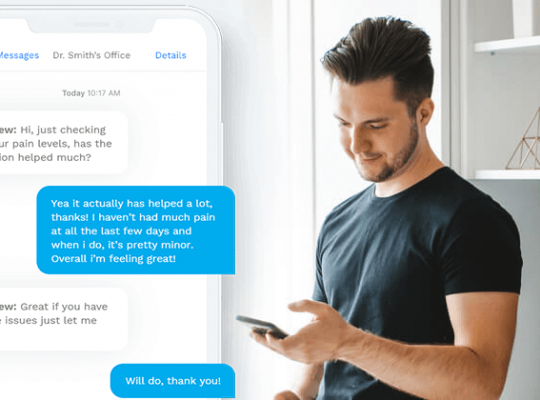
If your practice supports monitored two-way texting, you can invite a reply instead. Make sure someone owns those responses and that patients know when to expect an answer.
3. When a patient has questions about treatment
This is a good place for a reusable opening with a brief staff review.
Hi [First name], this is [Team member] from [Practice]. I’m following up on your recent visit. Would you like us to arrange a call to go over any questions before you decide on your next appointment?
If the patient has already asked about cost, a generic follow-up may feel inattentive. A team member can adjust the message to acknowledge that question and arrange the right conversation.
Keep sensitive treatment details in the appropriate communication channel. A reminder doesn’t need to repeat a patient’s diagnosis to be useful.
Decide what can run automatically, and what needs a person
Personalizing patient communications becomes easier when the team agrees on a few boundaries.
Routine appointment details are different from a patient saying they’re frightened about treatment. Software may help deliver the first message; the second deserves someone’s attention.
Situation | What software can help with | Where staff should step in |
Upcoming appointment | Send a reminder using supported appointment information | Handle changes, conflicting details, or unanswered questions |
Forms before a visit | Send the appropriate form request | Help patients who can’t access or complete it |
Recall outreach | Contact eligible patients using configured rules | Discuss concerns or help find a suitable appointment |
Treatment follow-up | Support a prepared message or follow-up task | Answer clinical questions and discuss individual circumstances |
Payment request | Provide a convenient payment link | Explain a disputed balance or discuss payment concerns |
The handoff matters as much as the message.
If a patient replies with a question, someone needs to review it. If an appointment changes, the old reminder should be updated or stopped where the system supports that behavior.
Before turning on a sequence, check what happens after the patient responds. That’s often where extra work begins.
Where Adit can fit into the process
Adit can help practices organize routine communication around the systems they already use.
Its appointment reminder tools support configurable reminders for practices with a supported, integrated EHR. The setup matters: review appointment statuses, reminder timing, and available filters so messages reach the intended patients.
For messages staff send during a conversation, Adit Quick Text provides shortcuts for common requests, including forms, appointments, and payments. That gives the team a starting point without requiring them to rebuild the same message each time.
Adit also documents patient communication preferences, helping teams account for the types of messages patients wish to receive.
Your PMS or EHR remains central to managing patient records and appointments. Before setting up communication rules, confirm which information your particular Adit integration reads or updates. Don’t assume every message, reply, or appointment change automatically updates every connected system.
The biggest time-saver may be knowing when to stop
A patient submits their paperwork. The form requests should stop.
A patient books their recall visit. They shouldn’t keep receiving messages asking them to schedule it.
A patient says they’d like time to consider treatment. Record that preference and agree on an appropriate follow-up.
Repeated messages can undo the care you put into the first one. They also create avoidable replies: “I already did this” or “I spoke to someone yesterday.”
For each automated message, ask:
- What makes this patient eligible to receive it?
- What change should stop or alter it?
- Who handles a reply?
- What happens if the software can’t recognize that the task is complete?
Where automatic stopping rules aren’t supported, assign a simple manual check. It’s better to understand that limitation before messages go out.
Try it with one recurring task first
You don’t have to rebuild your entire communication process at once.
Choose something your team repeats often, such as sending first-visit instructions. Review the current message, remove unnecessary information, and make the next step obvious.
Then test a few everyday situations: a new booking, a rescheduled visit, a cancellation, and a patient who needs help.
Once it’s running, ask your team what changed. Are they rewriting less? Are patients asking fewer repeat questions? Are replies reaching the right person?
Those answers are more useful than simply counting how many messages went out.
Personalized communication takes some preparation. The goal is for that preparation to reduce daily repetition and leave your team with more time for patients who need a conversation.
See Adit in action.Book a personalized demo to explore how its communication tools can support your practice’s reminders, everyday messages, and patient follow-up.
Frequently Asked Questions
1) What is personalized patient communication in dentistry?
It means tailoring a message to the patient’s situation, communication preferences, and next step. Examples include first-visit instructions for a new patient, an accurate reminder for a returning patient, or follow-up that acknowledges a question they’ve already asked.
2) Can dental communication software personalize messages automatically?
Yes, depending on the platform and its connection to your practice software. It may insert supported patient and appointment details or send messages based on configured rules. Practices should verify which fields, sending conditions, and stopping rules are available.
3) Why is personalized communication important in dentistry?
Relevant messages help patients understand what’s happening and what to do next. They can also reduce confusion caused by repeated requests, outdated appointment details, or follow-up that ignores an earlier conversation.
4) How can automated patient communication be personalized?
Start with messages for specific situations, such as a first appointment or recall visit. Use accurate information, respect communication preferences, and stop messages when they’re no longer relevant. Assign a team member to handle replies that need individual attention.
more about Adit?
Say goodbye to the hassle of using multiple tools. Adit centralizes your calls, texts, payments, reviews, and scheduling into one powerful dashboard. Simplify your operations and boost patient satisfaction today.
Schedule a Demo


Sushmita brings years of experience writing for the healthcare and dental technology space, with a focus on simplifying the challenges practices face every day. Her work blends industry insight, real-world examples, and clear messaging to help providers understand how the right tools can transform their business. She’s spent years working with healthcare brands, providers, and tech teams, helping them connect the dots between innovation and patient experience. And when she’s not writing for Adit, she’s building creative side projects and exploring new places.

Get a $25 Gift Card when you take a demo
Schedule a Demo
Get a $50 Gift Card
when you take a demo

No tricks. Just a demo
& $50 treat
Looks like you're out of bounds!
Hey there! Your current location falls outside Adit's area of operation. If this is unexpected, try disabling your VPN and refresh your page. For further assistance or to book a live demo, connect with us at 832-225-8865.
November 2 Amazon Demo Promo
Terms and Conditions
Last Updated: November 2, 2026Offer ends November 5, 2026, and is limited to prospective customers who sign an annual agreement before November 30, 2026. Gift card will be emailed to the company owner or established representative within 4 weeks of signing the annual agreement. Offer may not be combined with any other offers and is limited to one (1) gift card per office. Offer is not available to current customers or to prospective customers or individuals that have participated in a Adit demo during the prior six (6) months. Recipient is responsible for all taxes and fees associated with receipt and/or use of the gift card as well as reporting the receipt of the gift card as required under applicable federal and state laws. Adit is not responsible for and will not replace the gift card if it is lost or damaged, is not used within any applicable timeframe, or is misused by the recipient. Adit is not responsible for any injury or damage to persons or property which may be caused, directly or indirectly, in whole or in part, from the recipient’s participation in the promotion or receipt or use of the gift card. Recipient agrees to indemnify, defend and hold harmless Adit from and against any and all claims, expenses, and liabilities (including reasonable attorney’s fees) arising out of or relating to a recipient’s participation in the promotion and/or recipient’s acceptance, use or misuse of the gift card. This offer is sponsored by Adit Communications, Inc. and is in no way sponsored, endorsed or administered by, or associated with Amazon.

Thank You!
We appreciate your interest! Adit AI will be calling you in the next few minutes!



Why Adit?
Cut your software bill by up to 60% when you merge everything your dental office needs to run under one roof.

Centralize Communications
- Phones & TeleMed
- Emails & eFax
- Texting & Reminders
- Call Tracking and more!

Streamline Operations
- Patient Forms
- Online Scheduling
- Payments
- Reviews and more!

Boost Production
- Performance Dashboards
- Morning Huddle
- Claims & Collections
- Patient Profiles
- Follow Up Lists
- Year Over Year Metrics

Acquire More Patients
- Digital Marketing
- Website Design
- SEO
- Google Ads
- Facebook Ads
 Front Desk free for life when you sign up!
+ $50 Amazon Gift Card
Sign up by filling out the form