




How a VoIP Phone System Can Improve Communication in Your Dental Practice

A busy dental practice has a lot happening at once. Your front desk is checking in patients, confirming appointments, answering questions, and coordinating with the clinical team. In the middle of all this, the office phone keeps ringing.
Traditional phone systems can make these daily communication demands harder to manage, particularly as a practice grows or adds new locations. Dental teams need more than a basic phone connection. They need a reliable way to communicate with patients, coordinate internally, and stay connected throughout the workday.
That's where a VoIP phone system for dental practices can make a difference.
Voice over Internet Protocol (VoIP) allows dental offices to make and receive business calls over an internet connection. Modern systems can also offer features such as call routing, call recording, voicemail transcription, mobile accessibility, and integrations with dental practice management software.
But what makes VoIP useful for a dental office, and which features should you consider before choosing a provider?
In this guide, we'll explore how dental VoIP phone systems work, their essential features, the benefits they offer, and what to evaluate before investing in one.
What Is a VoIP Phone System for Dental Practices?
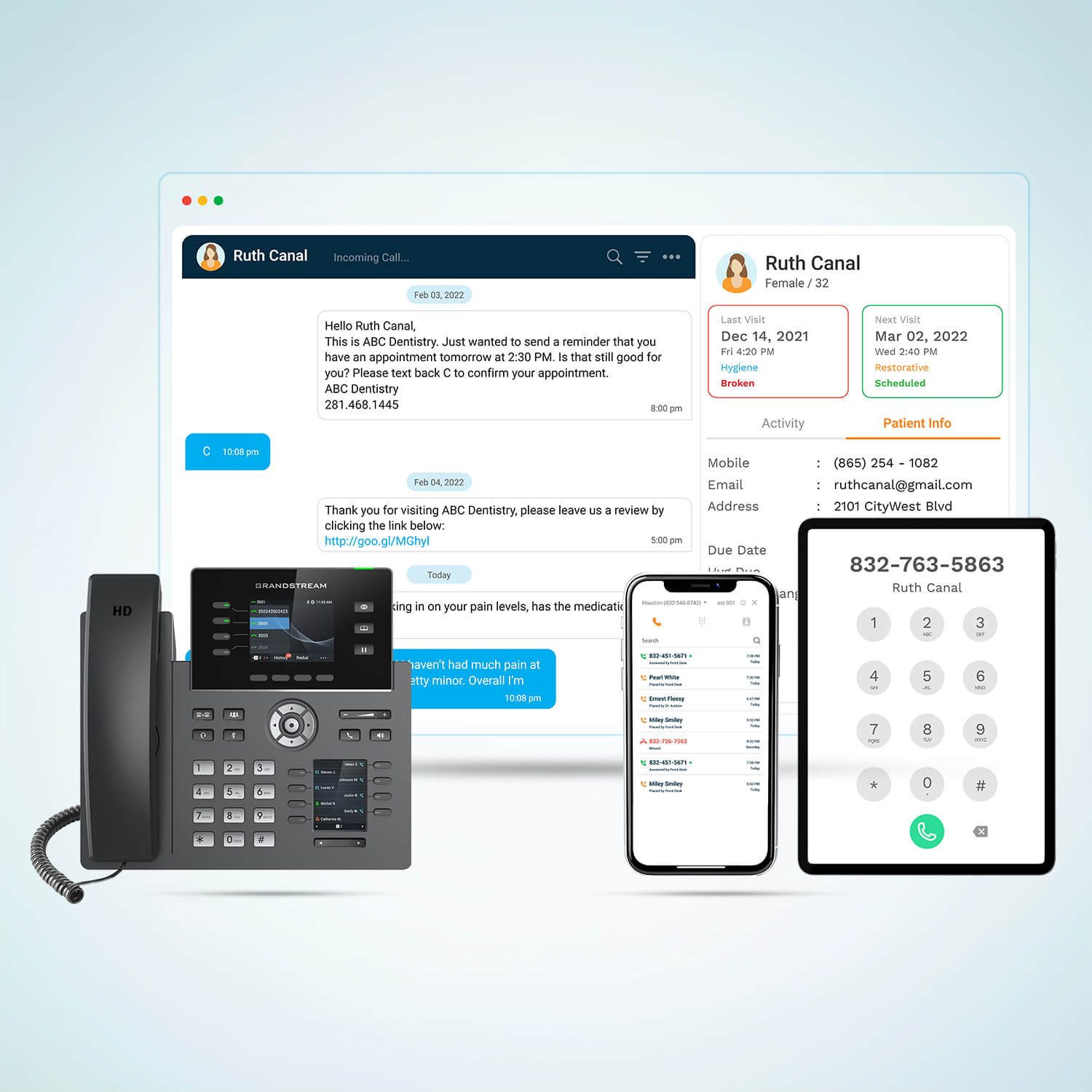
A Voice over Internet Protocol (VoIP) phone system is a communication solution that allows dental practices to make and receive calls using an internet connection rather than relying entirely on traditional telephone lines.
Instead of transmitting voice through conventional telephone infrastructure, VoIP converts voice signals into digital data and sends them over an IP network.
For dental offices, this means team members can manage business calls using compatible desk phones, computers, or mobile devices.
 Case Study
Tubb Family Dental boosts revenue 50% and attracts 30 more new patients each month with Adit How does a practice go from zero reviews to 200+ five-star ratings? When Dr. Kyle Tubb purchased his Amory, Mississippi, practice,...
Download Case StudyDepending on the provider, a dental VoIP phone system may also include call recording, automated call routing, voicemail management, call analytics, and software integrations.
Unlike a basic telephone setup, a modern cloud-based phone system can bring several communication capabilities together, giving dental teams more flexibility in how they manage their business calls.
How Does a Dental VoIP Phone System Work?
A dental VoIP system uses an internet connection to transmit voice communications between callers and your office.
Here's how a typical incoming call works:
- A patient calls your office: The patient dials your dental practice's business phone number.
- The VoIP system receives the call: The system processes the incoming call through its cloud or network infrastructure.
- The call follows a configured route: Depending on your settings, the call may reach a receptionist, a particular department, or an automated menu.
- A team member answers: The designated employee answers through a compatible desk phone, desktop application, or mobile device.
The exact process depends on your provider's configuration and the features included in your phone system.
VoIP vs. Traditional Phone Systems for Dental Offices
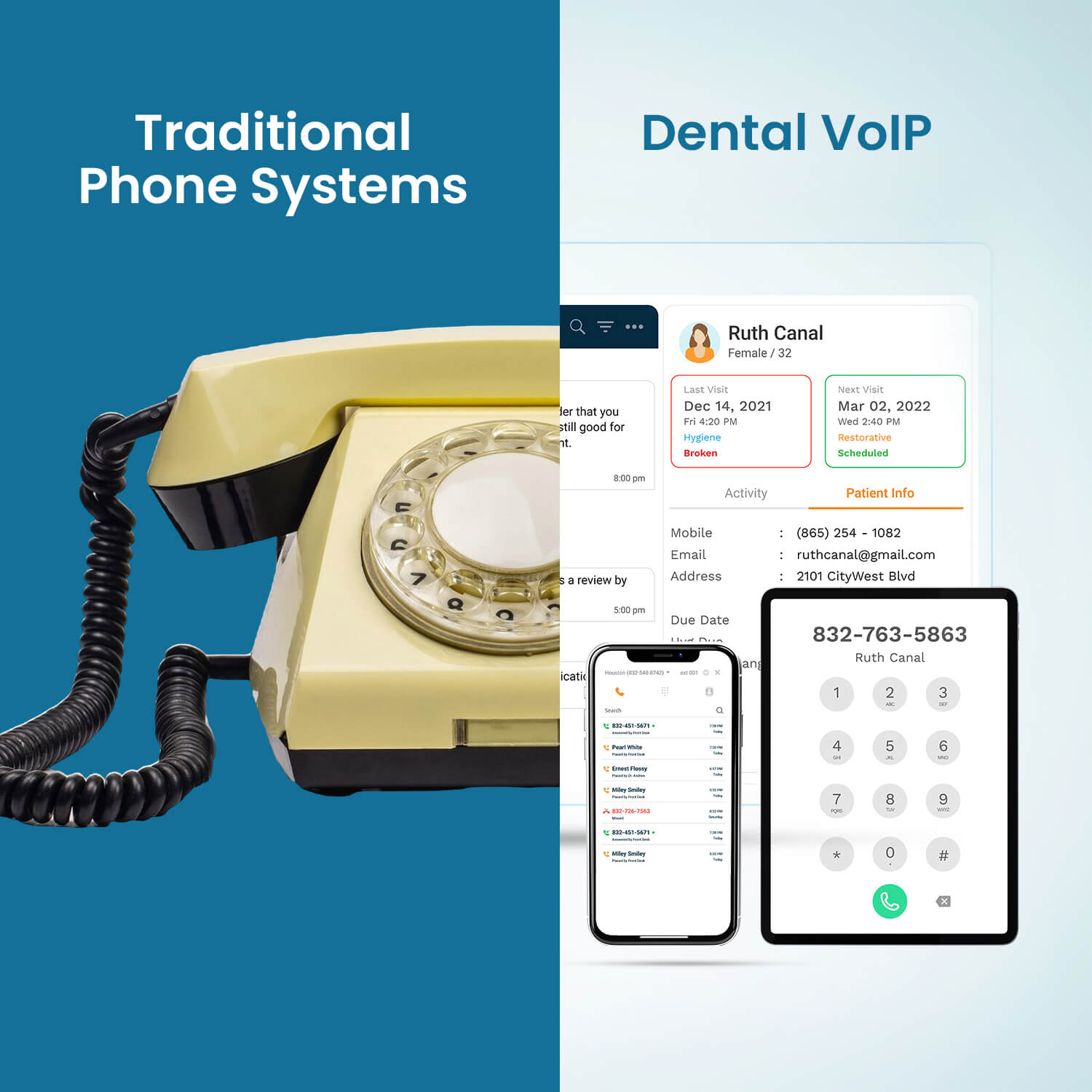
Traditional phone systems have served dental offices for years. However, changing communication needs have encouraged many practices to consider internet-based alternatives.
Here are some important differences:
| Feature | Traditional phone system | VoIP phone system |
|---|---|---|
| Connectivity | Traditional telephone lines | Internet connection |
| Device accessibility | Generally tied to physical phone setups | Compatible desk phones, computers, and mobile devices |
| Call routing | Depends on available phone system features | Configurable automated routing |
| Scalability | May require additional hardware or lines | Often easier to expand |
| Call analytics | Depends on the system | Available with supported solutions |
| Software integration | Often limited | Available through supported integrations |
| Remote accessibility | May require additional arrangements | Supported through compatible devices |
| Maintenance | May require physical infrastructure support | Often managed through cloud-based services |
The right option depends on your practice's infrastructure, budget, and communication requirements. A VoIP system may offer more flexibility, but its performance also depends on internet reliability and the provider's service quality.
10 Essential Features to Look for in a Dental VoIP Phone System
Not every VoIP phone system offers the same capabilities. Some provide basic internet-based calling, while others include advanced tools designed to support business communication.
When comparing providers, consider the following features and how they fit into your dental office's daily operations.
1. Smart Call Routing and Auto Attendant
An auto attendant helps direct incoming callers to the appropriate person or department without requiring your receptionist to transfer every call manually.
For example, a dental office could configure a phone menu with options for:
- Scheduling a new appointment.
- Rescheduling an existing appointment.
- Billing and payment questions.
- General office inquiries.
- Reaching a specific department.
Some systems also support more advanced routing rules based on business hours, employee availability, or predefined call flows.
This gives practices more control over how incoming calls are directed and helps create a consistent experience for callers.
2. Call Recording and Monitoring
Call recording allows dental practices to review conversations between patients and office staff, where legally permitted and appropriately disclosed.
For practice owners and office managers, recordings can provide useful insights into how communication takes place.
For example, reviewing a call may help a manager understand why a prospective patient didn't schedule an appointment or identify where a staff member needs additional training.
Useful capabilities include:
- Recording incoming and outgoing calls.
- Reviewing previous conversations.
- Monitoring call quality.
- Supporting employee training.
- Identifying communication opportunities.
Before enabling call recording, check applicable federal and state consent requirements. Recording laws vary across the United States.
3. Two-Way Patient Text Messaging
Patients increasingly expect convenient ways to communicate with healthcare providers. They may prefer sending a quick message instead of making a phone call for every appointment-related question.
A patient communication platform with two-way texting can help dental offices manage conversations through SMS.
Common uses include:
- Appointment confirmations.
- Appointment reminders.
- Scheduling updates.
- Follow-up messages.
- General patient inquiries.
When evaluating a solution, check whether messaging is included in the phone subscription or offered through a separate communication product.
Also verify the provider's support for appropriate patient consent, privacy safeguards, and applicable messaging requirements.
4. Dental Practice Management Software Integration
Your phone system should work with the software your dental team already uses.
Integration with dental practice management software (PMS) or electronic health record (EHR) platforms can reduce the need to switch between different applications.
Depending on the integration, features may include:
- Identifying incoming callers.
- Displaying relevant patient information.
- Accessing patient records.
- Supporting appointment-related workflows.
- Reducing repetitive data entry.
Before choosing a provider, ask which dental PMS platforms are supported and what information can actually be accessed or synchronized.
Don't assume that every provider offers the same integration capabilities.
5. Call Analytics and Reporting
A phone system should offer more than the ability to make and receive calls. Reporting features can help dental practice owners understand how their communication infrastructure is performing.
Depending on the platform, useful metrics may include:
- Total incoming and outgoing calls.
- Answered and missed calls.
- Average call duration.
- Call volume by employee.
- Call activity by time period.
- Call outcomes, where supported.
These insights can help managers understand communication patterns, evaluate performance, and identify opportunities to improve their office operations.
6. Voicemail-to-Text Transcription
Dental teams don't always have time to listen to every voicemail immediately.
Voicemail-to-text transcription converts recorded voice messages into written text, allowing staff to review the message more quickly.
For example, a patient may leave a message asking about an upcoming appointment or requesting a callback. Instead of listening to multiple recordings, an authorized team member can review the available transcription and determine the appropriate next step.
Look for systems that offer secure voicemail access, notifications, searchable messages, and transcription capabilities.
7. Mobile and Desktop Accessibility
A cloud-based dental phone system can give authorized employees access to business communications through compatible computers and mobile devices.
This is particularly useful for practice owners and managers who need to stay connected outside the office.
Consider whether your provider offers:
- Desktop calling applications.
- Mobile calling applications.
- Business caller ID.
- Call forwarding.
- Access to voicemail.
- Remote communication management.
Before implementation, confirm which features are available on each device and whether additional licenses are required.
8. Multi-Location Communication
Dental groups and DSOs often manage several offices with different teams, phone numbers, and communication requirements.
A VoIP system with multi-location capabilities can help centralize business communications while maintaining location-specific configurations.
Depending on the provider, these capabilities may include:
- Location-specific phone numbers.
- Centralized administration.
- Inter-office calling and transfers.
- Location-based call routing.
- Individual location reporting.
- Consistent communication settings.
For growing dental organizations, these capabilities can make it easier to manage communication across multiple practices.
9. After-Hours Call Routing and Call Forwarding
Dental patients may need to contact your office outside normal business hours.
A VoIP system with scheduling and forwarding capabilities can help practices configure how calls are handled when the office is closed.
For example, you can configure:
- Business-hour greetings.
- Holiday messages.
- After-hours voicemail.
- Calls forwarded to designated numbers.
- Routing for supported emergency communication workflows.
If your practice offers emergency dental services, confirm that the system supports the specific after-hours routing arrangements your team needs.
10. AI-Powered Call Handling
AI is introducing new possibilities for dental office communication.
AI-powered phone solutions can help practices automate certain interactions and manage routine incoming calls.
Depending on the solution, capabilities may include:
- Answering incoming calls.
- Responding to common questions.
- Collecting basic caller information.
- Directing calls to the appropriate team.
- Supporting appointment-related requests.
- Escalating conversations to human staff.
When evaluating AI phone technology, look beyond the marketing claims. Check whether it can integrate with your existing systems, handle complex requests appropriately, and transfer callers to a human when necessary.
For dental practices, protecting patient information and maintaining an appropriate escalation process should be priorities.
Benefits of Using a VoIP Phone System in a Dental Practice
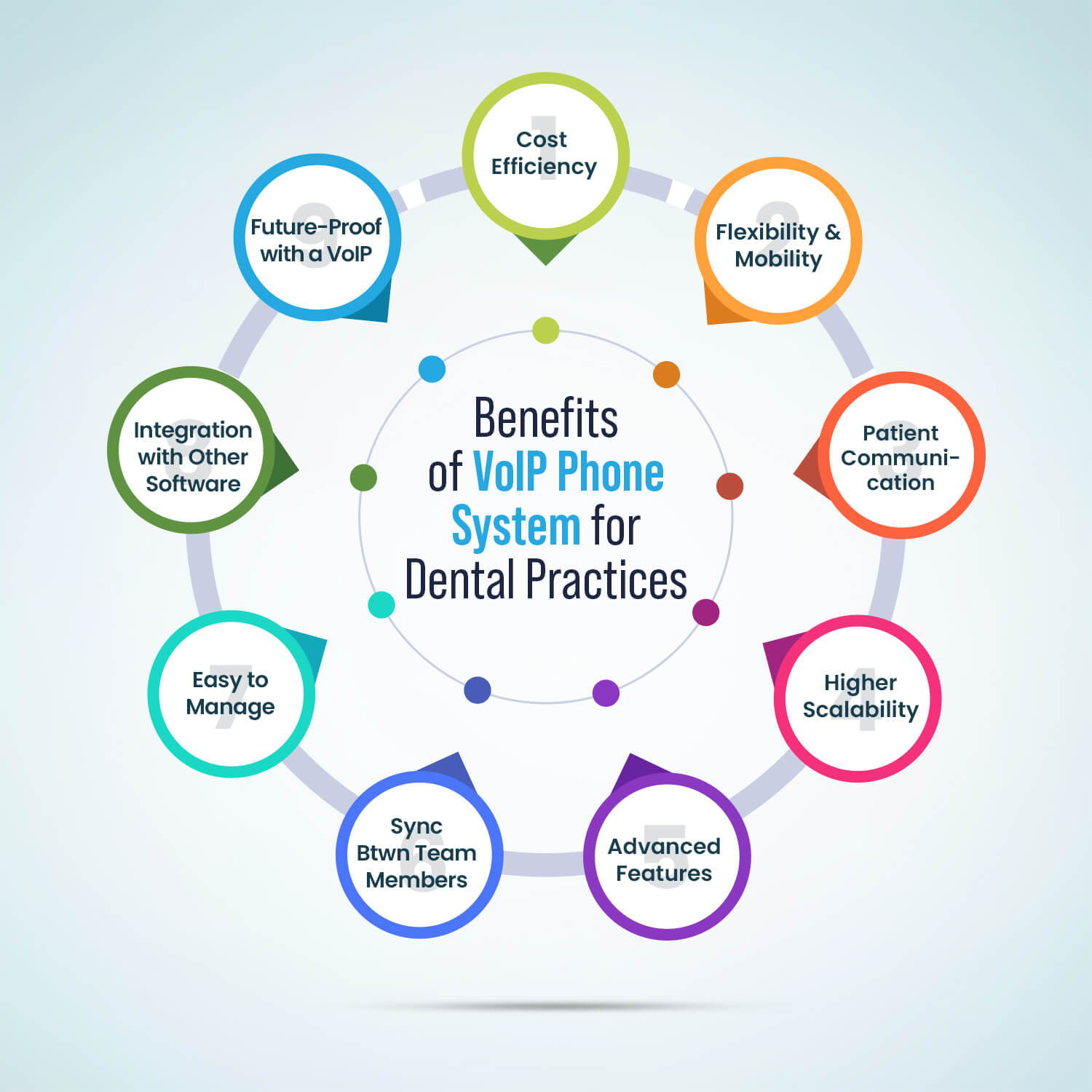
A dental VoIP phone system can offer several advantages beyond replacing traditional telephone lines. The right solution can support communication flexibility, improve visibility into phone activity, and provide capabilities that traditional systems may not offer.
Here are some of the key benefits.
1. Greater Flexibility for Your Dental Team
Traditional phone systems often depend on physical phone setups and fixed office infrastructure.
With a cloud-based VoIP solution, authorized employees may be able to manage business calls using compatible computers or mobile devices.
This flexibility can be particularly useful for practice owners overseeing multiple locations, managers working remotely, or employees who need access to office communications outside the front desk.
2. Better Visibility Into Communication Performance
Without reporting capabilities, it can be difficult for dental practice owners to understand how their phone systems are being used.
Call analytics can provide information about call volumes, duration, missed calls, and employee activity.
These insights help managers make more informed decisions about communication resources and identify areas where additional support or training may be needed.
3. More Organized Patient Communication
When calling, messaging, and other communication tools work together, dental teams can manage patient interactions more consistently.
For example, a patient may call to ask about an upcoming appointment and later receive a confirmation or reminder through text messaging.
A connected dental patient communication platform can help reduce the need to manage these interactions across disconnected applications.
4. Easier Expansion as Your Practice Grows
Adding employees, opening another location, or changing your office structure can increase communication requirements.
Cloud-based VoIP systems often make it easier to add users, extensions, and supported features without rebuilding an entire traditional phone infrastructure.
Before selecting a provider, confirm its pricing model, user limits, location support, and requirements for adding new extensions.
5. More Efficient Team Collaboration
Dental practices depend on coordination between front-desk employees, office managers, dentists, and clinical staff.
Communication tools such as internal messaging, call transfers, and supported conferencing features can help team members stay connected.
For instance, a receptionist may need to contact the office manager to clarify a scheduling request. A connected communication platform can make that interaction easier without requiring employees to leave their workstations.
6. Potential Cost and Maintenance Advantages
VoIP can reduce the need for certain traditional telephone infrastructure and may offer more flexible pricing as a practice expands.
However, savings depend on your current phone setup, the provider's subscription model, hardware requirements, and additional service charges.
Compare the total cost of ownership rather than assuming that every VoIP system will automatically be less expensive.
How to Choose the Right VoIP Phone System for Your Dental Practice
Choosing a phone system is an important operational decision. The cheapest solution may not provide the functionality your team needs, while a feature-heavy platform may include tools your practice will rarely use.
Before making a decision, evaluate these six areas.
1. Understand Your Practice's Communication Requirements
Start by identifying what your current phone system does well and where it falls short.
Consider:
- How many employees need access to business calls?
- How many locations does your practice operate?
- Do you need mobile and desktop calling?
- Do you need call recording and analytics?
- Is patient texting important?
- Do you require integrations with dental software?
Your answers will help you identify which capabilities are essential and which are optional.
2. Evaluate Internet Reliability and Network Requirements
VoIP relies on an internet connection, so network performance matters.
Before implementation, review:
- Available internet bandwidth.
- Network stability.
- Router and network configuration.
- Quality of Service (QoS) support.
- Backup internet options.
- Power backup for essential equipment.
Ask your provider about its recommended network requirements and call-quality troubleshooting process.
3. Compare Pricing and Contract Terms
VoIP pricing varies based on the provider, number of users, available features, and implementation requirements.
Consider the complete cost, including:
- Monthly user or license fees.
- Desk phone hardware.
- Installation and setup.
- Additional phone numbers.
- Call recording and analytics.
- PMS/EHR integration.
- AI features.
- Customer support and maintenance.
Request an itemized quote and clarify any long-term contract commitments before signing.
4. Check Dental Software Integration Capabilities
If your practice already uses dental PMS or EHR software, verify whether the phone provider supports integration with that specific platform.
Ask the vendor:
- Which software platforms are supported?
- What information is available during incoming calls?
- Is the integration included in the subscription?
- Are there additional implementation charges?
- How are integration issues handled?
A provider should be able to explain exactly what its integration supports rather than simply claiming compatibility.
5. Review Security and HIPAA Considerations
Dental practices in the United States handle protected health information (PHI). This makes privacy and security essential when evaluating communication technology.
Ask prospective providers about:
- Data encryption.
- User access controls.
- Secure storage and data retention.
- Call recording policies.
- Business Associate Agreements (BAAs), where applicable.
- Security documentation.
- Procedures for managing access and incidents.
A VoIP phone system is not automatically HIPAA compliant because it offers encryption. Compliance depends on the services involved, appropriate safeguards, contractual arrangements, configuration, and how the dental practice uses the technology.
Review these requirements with your compliance advisor before implementation.
6. Consider Scalability and Customer Support
Your communication requirements may change as your dental practice grows.
Choose a provider that can support additional employees, locations, and communication features without requiring a complete system replacement.
Also evaluate customer support availability, onboarding assistance, staff training, troubleshooting, and service-level commitments.
How Much Does a Dental VoIP Phone System Cost?
The cost of a dental VoIP phone system depends on the provider, number of users, phone hardware, available features, and integration requirements.
Some providers charge per user or extension, while others offer bundled subscriptions with different feature levels.
Rather than comparing only the advertised monthly price, consider the total cost of implementing and maintaining the system.
Factors That Influence Dental VoIP Pricing
Several factors can affect the overall cost:
- Number of users: More employees and extensions may increase subscription costs.
- Hardware requirements: Desk phones, headsets, and other equipment may require an additional investment.
- Advanced features: Call recording, analytics, and AI-powered services may be included or sold separately.
- Integrations: Connecting the system with dental PMS/EHR software may involve additional fees.
- Number of locations: Multi-location configurations may have different pricing structures.
- Support and maintenance: Premium support and implementation services may affect the overall cost.
Cloud-Based vs. On-Premise Phone System Costs
Cloud-based and on-premise phone systems have different cost structures.
Cloud-based systems generally use subscription pricing and require less dedicated on-site phone infrastructure. On-premise systems may involve higher initial hardware and installation costs, along with ongoing maintenance.
The better choice depends on your existing equipment, technical resources, number of locations, and long-term communication requirements.
Common Mistakes to Avoid When Choosing a Dental VoIP System
Even when a phone system offers attractive features, choosing the wrong solution can create unnecessary costs and operational difficulties.
Watch out for these common mistakes:
- Choosing based on price alone: A low monthly subscription may not include essential features such as integrations, analytics, or advanced call routing.
- Ignoring integration requirements: A system that cannot connect with your existing dental software may introduce additional manual work.
- Overlooking internet reliability: Poor network performance can affect call quality and service availability.
- Not reviewing security requirements: Dental practices should understand how the provider protects sensitive information and supports applicable compliance obligations.
- Ignoring future growth: A system that works for one office may not meet the requirements of a growing dental group.
- Not evaluating customer support: Implementation and ongoing technical support matter, especially when your phone system is essential to daily office operations.
How Adit Voice Supports Dental Practice Communication
Managing dental office communications shouldn't require your team to switch between multiple disconnected tools.
Adit brings patient communication and engagement capabilities together through an integrated platform designed for healthcare practices, including dental offices.
With Adit Voice, dental practices can manage business phone communications while connecting with other capabilities across the Adit platform.
Depending on the selected products and configuration, Adit offers:
- Cloud-based phone communication: Adit Voice helps dental teams manage their business phone communications.
- Patient messaging: Adit Engage supports two-way SMS and email communication, including patient reminders and campaigns.
- AI-powered communication:AI Front Desk, AI Care Coordinator, and AI Web Chat support different patient communication and engagement workflows.
- Appointment-related workflows: Online scheduling and automated reminders help practices manage patient interactions.
- Practice software integrations: Adit integrates with supported dental PMS/EHR platforms to help connect communication with existing practice workflows.
Instead of treating phone calls as an isolated function, dental practices can connect business communication with broader patient engagement activities.
Whether you operate a single dental office or manage multiple locations, Adit provides tools to support more connected patient communication.
Ready to explore a more connected way to manage dental practice communication?
Discover Adit Voice and see how Adit's patient engagement software can support your dental practice.
Final Thoughts
A dental phone system plays an important role in how your practice communicates with patients and coordinates daily operations.
A VoIP phone system can offer more flexibility than traditional telephone infrastructure while providing capabilities such as call routing, analytics, voicemail transcription, mobile access, and software integrations.
However, the best solution isn't necessarily the one with the most features. It's the one that fits your practice's communication requirements, works with your existing systems, and can support your future growth.
Take time to compare providers, understand their pricing, verify their integration capabilities, and review their security practices before making a decision.
With the right communication technology in place, your dental team can spend less time working around disconnected systems and more time focusing on the people who matter most: your patients.
Frequently Asked Questions About Dental VoIP Phone Systems
1. What is the best VoIP phone system for a dental practice?
The best VoIP phone system for a dental practice should offer reliable calling, flexible call routing, call recording, reporting, and compatibility with existing dental software. Practices should also evaluate pricing, security, mobile accessibility, scalability, and customer support before choosing a provider.
2. Is VoIP better than a traditional phone system for dental offices?
VoIP can offer more flexibility than traditional phone systems through internet-based calling, mobile accessibility, automated routing, and supported software integrations. However, the right choice depends on your practice's communication needs, internet reliability, existing infrastructure, and budget.
3. Is a VoIP phone system HIPAA compliant?
Not every VoIP phone system is automatically HIPAA compliant. Dental practices should evaluate the provider's security safeguards, encryption, access controls, data handling, and Business Associate Agreement (BAA) arrangements where applicable. The practice must also use and configure the service appropriately.
4. Can a dental VoIP phone system integrate with practice management software?
Yes. Some VoIP providers support integrations with dental practice management and EHR platforms. Depending on the integration, staff may be able to identify incoming callers, access relevant patient information, and connect phone activity with existing workflows. Always verify compatibility with your software provider.
5. Can dental offices use VoIP across multiple locations?
Yes. Many cloud-based VoIP solutions support multiple locations through centralized administration, location-specific numbers, call transfers, and configurable routing. These capabilities can help dental groups manage business communications across their offices.
6. Can AI answer phone calls for a dental practice?
Yes. AI-powered phone solutions can help answer incoming calls, respond to common questions, collect caller information, and support appointment-related requests. Capabilities vary by provider, so evaluate integration options, human escalation, accuracy, and data security.
7. What should dental practices consider before switching to VoIP?
Before switching, evaluate internet reliability, existing phone infrastructure, software compatibility, required features, pricing, security, and customer support. Also ask about number porting, implementation timelines, staff training, and backup communication arrangement.
more about Adit?
Say goodbye to the hassle of using multiple tools. Adit centralizes your calls, texts, payments, reviews, and scheduling into one powerful dashboard. Simplify your operations and boost patient satisfaction today.
Schedule a Demo


Josh has made a career working with large DSO organizations and leveraging his extensive sales experience to build partnerships with influential doctors and organizations within the dental industry. He travels the US as an expert guest speaker in medical seminars teaching doctors how to streamline their practices with the latest technology.

Get a $25 Gift Card when you take a demo
Schedule a Demo
Get a $50 Gift Card
when you take a demo

Every missed call costs you!
3 quick questions. One eye-opening estimate.
Your estimate
if your average is higher.
The production that you missed in this year
$29,000 – $42,000production back?

*Offer valid Nov 1–30, 2026. Your account executive sends the $50 Amazon gift card after your demo. The additional $150 applies when you sign up for an annual plan paid upfront. Terms apply.
Looks like you're out of bounds!
Hey there! Your current location falls outside Adit's area of operation. If this is unexpected, try disabling your VPN and refresh your page. For further assistance or to book a live demo, connect with us at 832-225-8865.
November 14 Amazon Demo Promo
Terms and Conditions
Last Updated: November 14, 2026Offer ends November 17, 2026, and is limited to prospective customers who sign an annual agreement before November 30, 2026. Gift card will be emailed to the company owner or established representative within 4 weeks of signing the annual agreement. Offer may not be combined with any other offers and is limited to one (1) gift card per office. Offer is not available to current customers or to prospective customers or individuals that have participated in a Adit demo during the prior six (6) months. Recipient is responsible for all taxes and fees associated with receipt and/or use of the gift card as well as reporting the receipt of the gift card as required under applicable federal and state laws. Adit is not responsible for and will not replace the gift card if it is lost or damaged, is not used within any applicable timeframe, or is misused by the recipient. Adit is not responsible for any injury or damage to persons or property which may be caused, directly or indirectly, in whole or in part, from the recipient’s participation in the promotion or receipt or use of the gift card. Recipient agrees to indemnify, defend and hold harmless Adit from and against any and all claims, expenses, and liabilities (including reasonable attorney’s fees) arising out of or relating to a recipient’s participation in the promotion and/or recipient’s acceptance, use or misuse of the gift card. This offer is sponsored by Adit Communications, Inc. and is in no way sponsored, endorsed or administered by, or associated with Amazon.

Thank You!
We appreciate your interest! Adit AI will be calling you in the next few minutes!


Why Adit?
Cut your software bill by up to 60% when you merge everything your dental office needs to run under one roof.

Centralize Communications
- Phones & TeleMed
- Emails & eFax
- Texting & Reminders
- Call Tracking and more!

Streamline Operations
- Patient Forms
- Online Scheduling
- Payments
- Reviews and more!

Boost Production
- Performance Dashboards
- Morning Huddle
- Claims & Collections
- Patient Profiles
- Follow Up Lists
- Year Over Year Metrics

Acquire More Patients
- Digital Marketing
- Website Design
- SEO
- Google Ads
- Facebook Ads
 Front Desk free for life when you sign up!
+ $50 Amazon Gift Card
Sign up by filling out the form